 John Nnamani
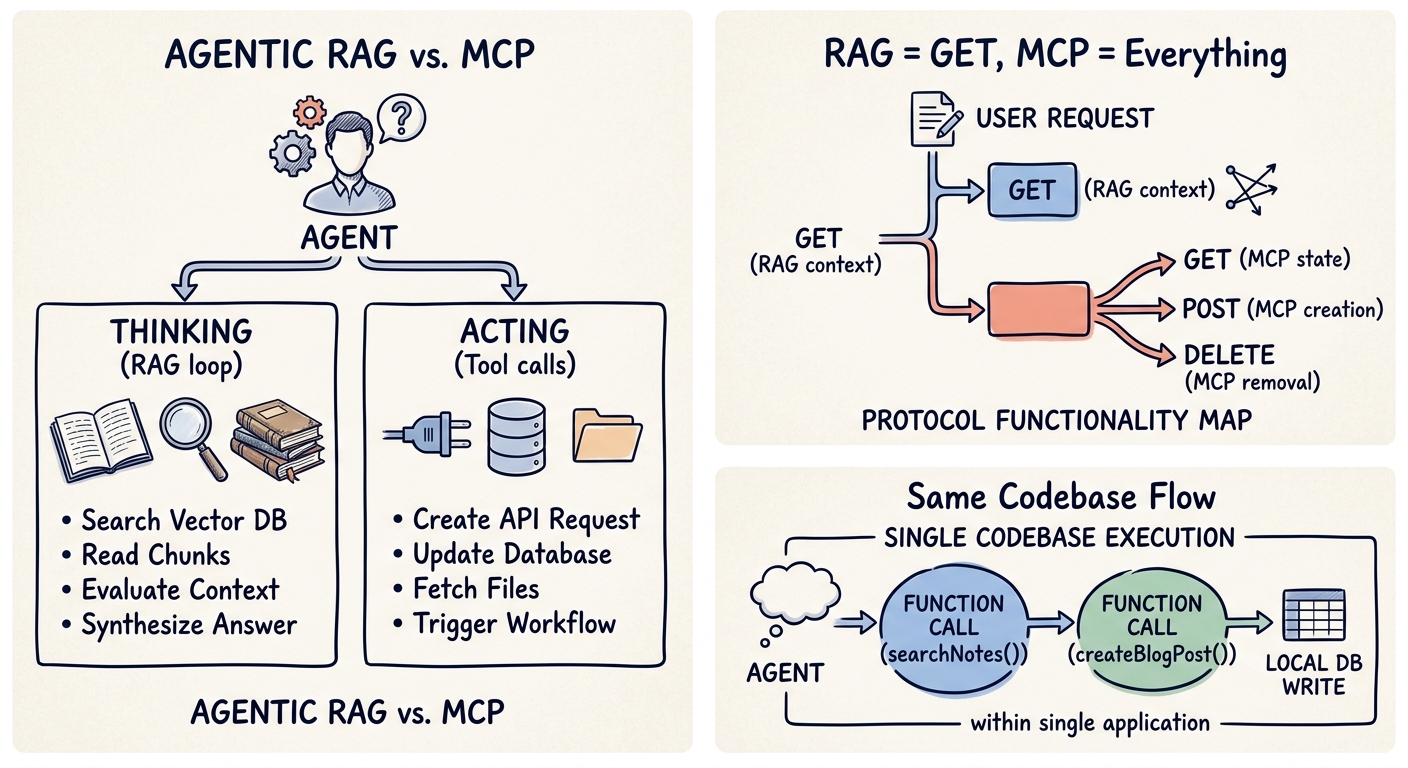
Lately, I’ve been taking the LLM Zoomcamp course, diving deep into concepts like Agentic RAG where I learned how agents work and how to build agentic systems. At the same time, we had this ongoing architectural debate at work on whether to use API or MCP.
We have our legacy codebase(not necessarily legacy) where everything currently lives — our core logic, and everything needed to make decisions about the business. Then, we created a brand-new codebase specifically built to handle modern AI and "Agentic stuff."
Naturally, an argument started:
- Where do we put new projects?
- Why can’t we just hit REST endpoints?
- Do we actually need MCP?
So many other questions and doubts but just to highlight a few. All this back-and-forth got me digging deep into how Agentic RAG, MCP, and traditional APIs fit together. If you’ve been feeling confused about these concepts or you are just curious about the difference between the two, here is how I broke it down.
Agentic RAG vs. Agent using MCP: What's the Actual Difference?#
After I've done a lot of research and actually creating an MCP myself, here’s the thing: Agentic RAG and MCP are not competing choices. They solve two completely different problems in an AI system.
- Agentic RAG is a Reasoning Pattern for smart, iterative search. Traditional RAG just takes a user prompt, pulls the top 3 or 5 vector matches, and feeds them to the LLM. Agentic RAG adds a loop around that. The agent can evaluate if the retrieved context is actually helpful, rewrite the search query if the results are bad, or check multiple data sources until it’s satisfied.
- MCP (Model Context Protocol) is an Infrastructure Standard. It’s basically a universal interface for how agents connect to tools, APIs, databases, and local file systems without you having to write custom code every single time to call those services.
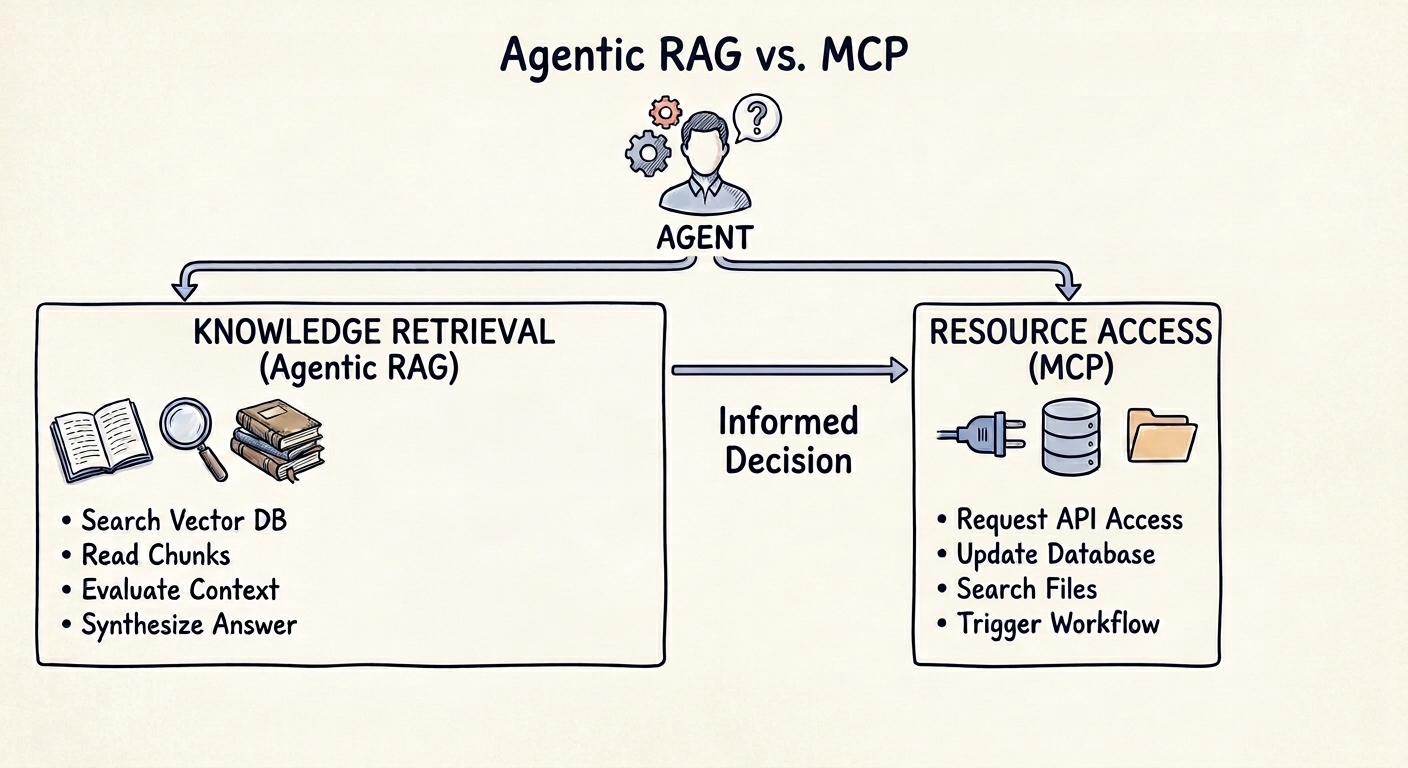
I was able to summarize this for myself: Just like the name Agent, it is an LLM that does something for you, but because it doesn't have context on what it needs except from general knowledge it was trained with, you give it more information and it's going to use that to make decisions on its own. Then think of MCP as the "medium" that gives your "agents" abilities to perform actions that enables it to complete its tasks.
Does Connecting to "Internal" Systems Make MCP Agentic RAG?#
This was the first question that came to mind after I've done a lot of analysis in my mind. "If I'm able to pass my search functions to the LLM as tools to give it more context, I can also pass my action functions, does that make it MCP?". This also came up directly during our work debate. Since our data lived inside our private repository, I also wondered: If I’m connecting my new agent to an internal system instead of an external tools, does that automatically make it RAG?
The short answer is No.
Whether a system is internal (your private Postgres DB, internal microservice) or external (Stripe, GitHub) only describes where the data lives. It doesn't define the pattern you are using.
- If your agent runs
mcp_db_execute_query("UPDATE users SET status = 'active'")on your internal network, that is tool/action execution via MCP, not RAG. - If your agent searches an internal vector database of company documentation to learn how your legacy user status system works before answering developer question, that is RAG.
Is RAG just GET while MCP is POST, UPDATE, and DELETE?#
To make sense of all this mentally, I tried mapping it back to classic REST HTTP verbs. I thought: Okay, so RAG is for reading (GET), while MCP is for taking actions (POST, PUT, DELETE), right?
This is a great mental model, and it gets you about 80% of the way there, but with one key detail: MCP handles GET requests too!
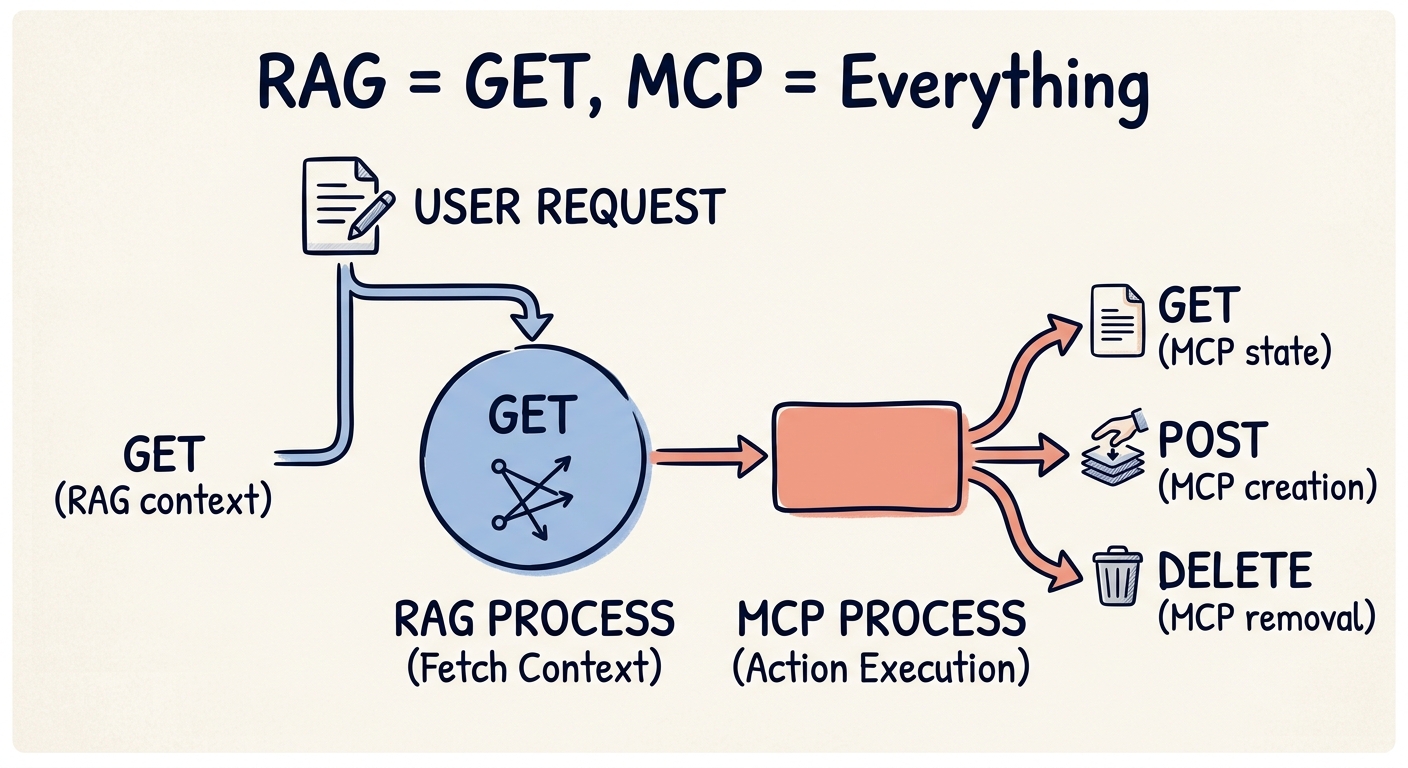
- RAG is strictly Read-Only (
GET): Performing RAG is safe and idempotent. Querying your doc store 100 times will never drop a table or trigger an email. It purely fetches context. - MCP is the whole protocol: MCP can execute
POSTactions (like opening a Pull Request), but it can also doGEToperations (like reading a database schema or listing directory files). In fact, you can even wrap a RAG retriever inside an MCP tool.
If Everything Lives in the Same Codebase, Do You Even Need a Protocol?#
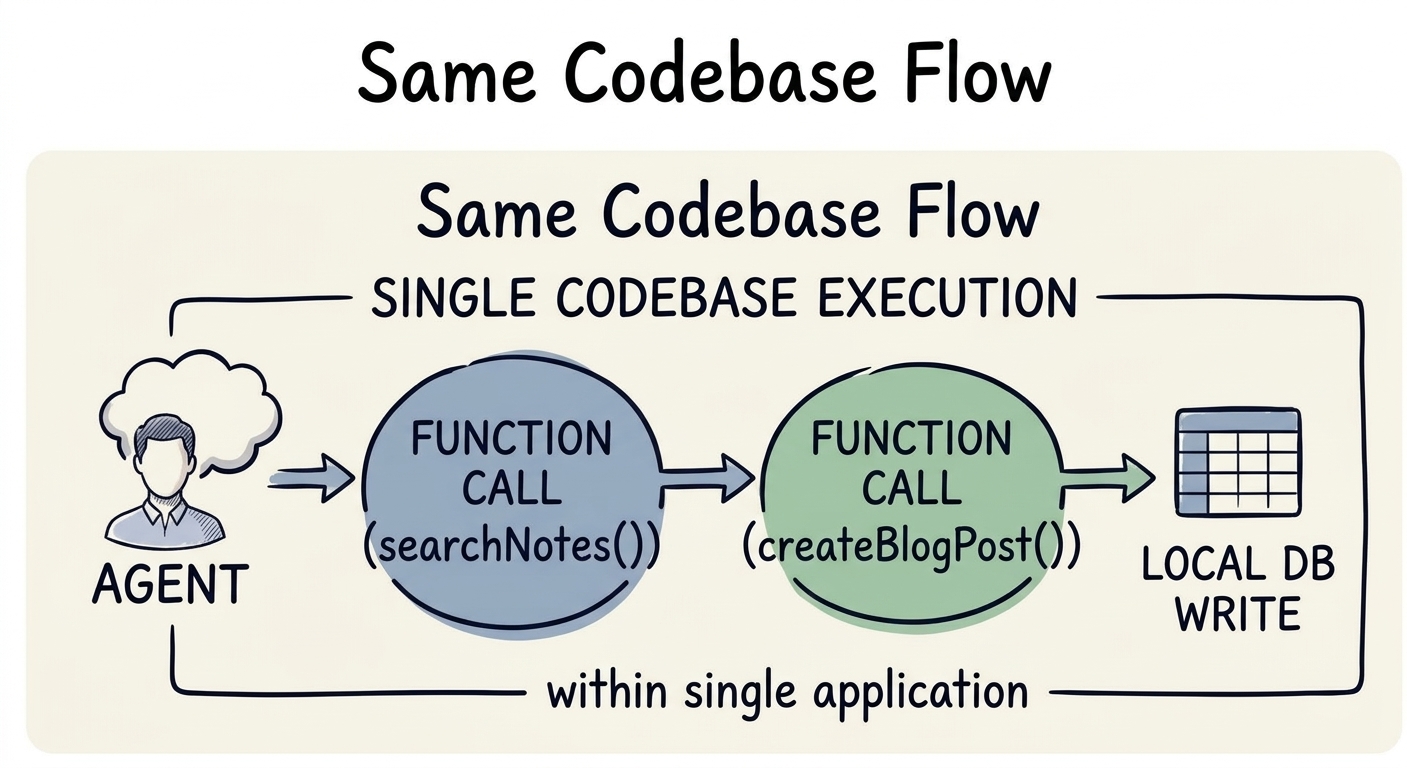
So, why do I even need a protocol in the first place? Imagine I want an agent that searches my old notes for context, generates a post, and then calls a function to save that post to my database. If all of this code lives in the exact same application repo, do I really need MCP?
No. If everything is in a single codebase, you do NOT need MCP.
MCP is built for decoupling—allowing separate, independent server processes to expose tools to AI models over a standard transport protocol. Now, "decoupling" is the word.
If your agent logic, your search function, and your database write function all live in the same monolithic app, you don’t need network protocols or MCP servers. You simply write regular TypeScript or Python functions (searchNotes() and createBlogPost()) and pass them directly into your LLM’s native tool/function-calling array.
Why Not Just Use REST APIs Instead of MCP?#
This was the core argument at work. If our new AI service needed to talk to our legacy codebase, why not just use the existing standard REST endpoints? Why create entirely new MCPs?
Here is what I realized: REST APIs were built for deterministic software. MCP was built for probabilistic agents.
If you try to connect an AI agent to 10 different REST APIs using traditional methods, you hit three big headaches:
- Every REST API has different headers, auth methods, and JSON payloads. You end up writing custom wrapper functions for every single endpoint just to parse them into LLM-friendly schemas.
- With traditional REST APIs, you have to hardcode every tool into the prompt. With MCP, an agent can connect to an MCP server at runtime and ask: "What tools and resources do you have available?"
- An MCP server written for a database or service can be instantly plugged into LangGraph, Cursor, or Claude Desktop without writing new integration code for each framework.
Note to My Younger Self#
If you want to architect an agentic system, here is the rulebook:
1. When to use RAG (or Agentic RAG)#
Use RAG when your agent's primary problem is knowledge and context. If the agent needs to search unstructured text, documentation, code repositories, or past notes to avoid hallucinating before it gives an answer, that's RAG. Make it Agentic RAG when a simple single search isn't enough and the agent needs to evaluate and refine its own searches.
2. When to use Direct Functions#
Use direct local functions when everything lives in the same codebase, or when you are building a simple, tightly coupled applications. Don't overengineer your stack with MCP if a simple function call solves the problem.
3. When to use MCP#
Use MCP when you are building a modular, decoupled system.
- If your application needs a standardized, clean way to expose tools and data to other agentic services.
- If you want your tools to be framework-agnostic so you can switch your agent orchestrator tomorrow without rewriting your tool layer.
Keep things simple, and always build for clarity first!